
History and Theories · Fact Check Series
Born When?
Where the Generation Names Came From and Why Nobody Agrees on the Years
About This Page
A while back I saw a colorful graphic going around Instagram called "Generations by Birth Year." It listed every generation from the Greatest Generation to Generation Beta, the years each one was born, and how old each group is in 2026. Thousands of people had shared it. Some of it was right. Some of it was off. And it got me asking questions I couldn't answer off the top of my head. Who decided I belong to one generation and not the next? Who came up with these names? Why is one generation 19 years long and another only 15? Why does every website give slightly different years?
For the record, I was born in 1966. That makes me Generation X by Pew's years (1965 to 1980) and by Strauss and Howe's (1961 to 1981). By one year, it also means I just missed Generation Jones, the in-between group of late Boomers born from 1954 to 1965.22 I turn 60 in 2026, and I can tell you that a birth year explains some of my story, but not all of it.
This page answers those questions with sources you can open yourself. It explains what a generation is, where each name came from and who coined it, why the year ranges differ, why the experts still argue about the cutoffs, and how much the labels can and can't tell you about a person. At the end I check that Instagram graphic line by line and give a verdict on the most common claims about generations: True, Partly true, False (debunked) or Inconclusive.
Every fact has a small number that matches a source in the list at the bottom of this page. Where I couldn't confirm something, I say so. Information on this page is current as of November 18, 2026.
One note on ages. When this page says someone is a certain age "in 2026," it means the age they turn on their birthday in 2026. Before their birthday they are one year younger. The Instagram graphic counted ages the same way.
Part 1: What Is a Generation?
The word "generation" gets used two different ways, and mixing them up causes a lot of the confusion.
A family generation
The first meaning is the one in your family tree: you, your parents, your grandparents. A family generation is the gap between a parent's birth and their child's birth. That gap is longer than most people think. A 2023 study from Indiana University, published in the journal Science Advances, used DNA (deoxyribonucleic acid) to estimate that across the last 250,000 years the average age at which humans had children was 26.9 years. Fathers averaged 30.7 years and mothers 23.2 years.2 So when someone says a generation is "about 25 to 30 years," they are talking about families, and they are about right.
A social generation, or cohort
The second meaning is the one behind labels like Baby Boomer and Millennial. Here a generation is a group of people born in the same stretch of years who grew up through the same big events. Researchers call this a birth cohort. These groups are shorter than family generations. Pew Research Center, the Washington, D.C., research group whose year ranges most American news outlets use, says generations are typically groups of people born over a 15 to 20 year span.3 In 2023 it put it more tightly: "A typical generation spans 15 to 18 years."5
The idea that shared events shape an age group comes from a German sociologist named Karl Mannheim. In a 1928 essay, "The Problem of Generations," he argued that being born around the same time is not enough by itself. What makes a generation is living through the same history at the same stage of life, especially in your teens and early twenties.1 Almost every modern generation label rests on that idea, whether the people using it know Mannheim's name or not.
Age, period and cohort
Researchers who study generations try to separate three things.3 An age effect is something that changes as anyone gets older, like caring more about health care at 70 than at 20. A period effect is something that hits everyone at once, like the way trust in government dropped across every age group after Watergate.5 A cohort effect is the part that really belongs to a generation, something people born in a certain window carry with them for life. Telling these apart is hard. Pew notes that if you know any two of them, the third is locked in, which makes them tricky to measure separately.3 That is one reason careful researchers are slower to blame a trait on a generation than social media is.
Part 2: Who Names the Generations?
You might ask, "Is there an official list somewhere?" The short answer is no. No government agency, university or international body sets the names or the years for every generation.
In the United States the Baby Boom is the one exception. Pew says Baby Boomers are "the only generation officially designated by the U.S. Census Bureau," because the boom was a real, measurable surge in births after World War II.4 Every other generation's years were picked by somebody who needed a line to draw: researchers, authors, journalists, magazine editors and marketing firms.12
The names come from the same mix of people. A name sticks when enough newspapers, books and advertisers repeat it. Some names were coined years before they caught on, and the person who made a name famous often isn't the person who first used it. Here is who is behind the names you hear most.
Part 3: The Generations One by One
The years below are the ones Pew Research Center uses unless I say otherwise, because they are the most widely repeated in the United States. Other sources use different years, and Part 4 explains why.
The Lost Generation (born about 1883 to 1900)
These are the people who came of age during World War I. The name is usually credited to the writer Gertrude Stein. Ernest Hemingway made it famous in 1926 by putting her line "You are all a lost generation" at the front of his novel The Sun Also Rises.9, 14 Time gives the birth years as roughly 1880 to 1900, and the 1883 to 1900 range is also common.9, 16 No one from this generation is living today.
The Greatest Generation (born 1901 to 1927)
These Americans grew up during the Great Depression, and many fought or worked through World War II. The name comes from NBC News anchor Tom Brokaw's 1998 book The Greatest Generation.15 Before Brokaw, historians William Strauss and Neil Howe had called the same group the G.I. Generation in their 1991 book Generations, and they used the years 1901 to 1924.9, 17 Pew uses 1901 to 1927, the same as the Instagram graphic.16 One of Pew's own reports simply says "those born before 1928."3
The Silent Generation (born 1928 to 1945)
These are the children of the Depression and World War II who came of age in the early 1950s. The name comes from a Time magazine essay in November 1951 called "The Younger Generation," which described the young people of the day as quiet and careful compared to the generation before them.9, 10 Pew uses 1928 to 1945.3 Encyclopaedia Britannica points out that the start year shows up as 1925, 1928 or 1929 depending on who you ask, and the end year as 1942 or 1945.10 Strauss and Howe used 1925 to 1942.9
Baby Boomers (born 1946 to 1964)
This is the only generation defined by hard numbers. After World War II births jumped and stayed high for almost two decades. The United States saw about 76 million births during the boom, and annual births topped 4 million every year from 1954 through 1964.6 The Census Bureau and Pew both use 1946 to 1964.4, 6 That makes the Boomers 19 years long, longer than most generations. The oldest Boomers turn 80 in 2026.6
The phrase "baby boom" is old. LIFE magazine used it in 1941, and the general idea goes back to the 1800s. The earliest known printed use of "baby boomers" was in a Newport News, Virginia, newspaper in January 1963.13 Time says the term first appeared in the Washington Post in 1977, so even the history of this name depends on who did the digging.9
Generation X (born 1965 to 1980)
Generation X has the most tangled name history of all. The label first showed up in a 1950s photo essay by the war photographer Robert Capa.9, 12 In 1964 two British journalists, Jane Deverson and Charles Hamblett, published a book about British youth called Generation X.19 In 1976 a young Billy Idol named his punk band Generation X after that book, which his mother owned.12, 19 The name stuck to this generation after Canadian author Douglas Coupland's 1991 novel Generation X: Tales for an Accelerated Culture.20 So Coupland made the name popular, but he didn't invent it.13 Pew uses 1965 to 1980.3 Strauss and Howe called this group the 13th Generation and used 1961 to 1981.18
Millennials, also called Generation Y (born 1981 to 1996)
Historians William Strauss and Neil Howe coined the name Millennials in their 1991 book Generations, because this group would come of age around the year 2000.12, 17 In 1993 the trade magazine Advertising Age used "Generation Y" for the same group, since it came after X.12 Both names mean the same people. Millennial won out, and Advertising Age itself gave in to the name in 2012.12
The end year is where the arguing starts. In 2015 Pew described Millennials as born 1981 to 1997.3 In 2018 it settled on 1996 as the last Millennial birth year, pointing to shared events like the September 11 attacks, which most Millennials were old enough to understand and most of Gen Z barely remembers, and the 2008 recession, which hit Millennials as they entered the workforce.4 Strauss and Howe used 1982 to 2005, a much longer span.18
Generation Z (born 1997 to 2012)
Pew starts Gen Z in 1997.4 It used 2012 as a tentative end year in 2019 and has not announced a firm one.21 The U.S. Library of Congress and Statistics Canada both use 1997 to 2012, citing Pew.21 The name simply comes after X and Y. Other names, like iGen and Zoomers, never fully caught on.21
Generation Alpha (born 2010 to 2024)
Australian social researcher Mark McCrindle and his firm named this group. McCrindle's team ran a national survey in Australia in 2005 that asked people to suggest a name for the generation after Z, and "Alpha" came out of it.8 The idea was to start over with the Greek alphabet instead of running past Z. McCrindle uses 2010 to 2024.7 Note that this start year overlaps with the 2010, 2011 and 2012 years that Pew-based charts still count as Gen Z.
Generation Beta (born 2025 to 2039)
McCrindle also named Generation Beta, the children being born right now, and set the years 2025 to 2039. The firm has already reserved Gen Gamma (2040 to 2054) and Gen Delta (2055 to 2069).7 McCrindle says it picked a standard 15-year span on purpose so future researchers can compare generations evenly, and it expects many of Gen Beta to live to see the 22nd century.7 The oldest members of Gen Beta turn 1 in 2026.
Part 4: Why the Years Don't Match
If you've looked this up before, you've probably seen a different set of years every time. Here is why.
Nobody owns the definitions. Since only the Baby Boom is officially designated, every other line is a judgment call made by whoever is doing the study.4 Pew says plainly: "Generational cutoff points aren't an exact science. They should be viewed primarily as tools."4 In 2015 it called them "guidelines, rather than hard-and-fast distinctions."3
Only one generation is based on a measurable event. The Baby Boom starts and ends with real changes in the birth rate.6 Every other generation is defined by shared experiences, like a war, a new technology or an economic crash, and people disagree about which events matter most and what age you need to be to feel them.
Different groups have different jobs to do. A researcher comparing survey answers wants groups that are useful for analysis.4 A housing researcher at Harvard set up 20-year generations (1945 to 1964, 1965 to 1984 and 1985 to 2004) so they would line up with Census age brackets.11 A marketing firm wants a catchy, even span. McCrindle chose exactly 15 years for every generation for that reason.7 Strauss and Howe tied their generations to roughly 20-year historical eras.18 Each choice makes sense for its purpose, and each one gives different years.
Countries differ. The events that shape an age group in Australia, Japan or Canada are not the same as in the United States. Japan's statistics bureau and the Australian Bureau of Statistics each use different Gen Z years than Pew does.21
Researchers change their minds. Pew itself moved the Millennial end year from 1997 to 1996.3, 4 The Census Bureau, in a 2022 report, described Gen Z as born 1997 to 2013, one year longer than Pew.21
Mistakes get copied. Even well-known outlets slip. One 2014 NPR article said the Silent Generation name first appeared in Time in 1961, but Time, Pew and Britannica all say 1951.3, 9, 10, 12 Time's own article dated the Generation X book to 1965, while most sources say 1964.9, 19 Once a wrong year lands in a popular graphic, it spreads faster than any correction.
Same generation, different years
Here is how four sources draw the lines. Dashes mean the source doesn't name that group or uses a different name.
| Generation | Pew Research | Strauss and Howe | McCrindle | Instagram graphic |
|---|---|---|---|---|
| Greatest / G.I. | 1901-1927 | 1901-1924 | - | 1901-1927 |
| Silent | 1928-1945 | 1925-1942 | - | 1928-1945 |
| Baby Boomers | 1946-1964 | 1943-1960 | - | 1946-1964 |
| Gen X / 13th | 1965-1980 | 1961-1981 | - | 1965-1980 |
| Millennials | 1981-1996 | 1982-2005 | - | 1981-1996 |
| Gen Z | 1997-2012* | - | 1995-2009 | 1997-2012 |
| Gen Alpha | - | - | 2010-2024 | 2013-2024 |
| Gen Beta | - | - | 2025-2039 | 2025-2039 |
* Pew starts Gen Z in 1997 and has used 2012 only as a tentative end year.4, 21 Sources: Pew 3, 4, 16; Strauss and Howe 9, 18; McCrindle 7, 21; graphic 25.
Gen Z alone has at least seven definitions
To show how loose this really is, here are the Gen Z birth years used by different official and research groups:21
| Source | Gen Z birth years |
|---|---|
| Pew Research Center (tentative end) | 1997-2012 |
| U.S. Library of Congress and Statistics Canada | 1997-2012 |
| U.S. Census Bureau (2022 report) | 1997-2013 |
| Australian Bureau of Statistics (2021 Census) | 1996-2010 |
| Statistics Bureau of Japan (2020 Census) | 1995-2010 |
| McCrindle (Australia) | 1995-2009 |
| Jean Twenge, iGen (2017) | 1995-2012 |
Part 5: Stuck in Between
If you were born near a cutoff year and never felt like you fit your label, you're not alone. Two in-between groups have names of their own.
Generation Jones covers people born from 1954 to 1965, the second half of the Baby Boom. Cultural commentator Jonathan Pontell coined the term. His point was that someone born in 1962 grew up in a very different world than someone born in 1947, even though both are called Boomers.22
Xennials covers people born from about 1977 to 1983, between Gen X and the Millennials. Writer Sarah Stankorb coined the word in a 2014 article in GOOD magazine. The usual description is an analog childhood and a digital young adulthood: you grew up with a landline and a cassette player and got your first cell phone as an adult.23
People born within a few years of any cutoff are often called cuspers. They tend to share traits with the generations on both sides, which is one more reason a single birth year can't tell you much about a single person.
Part 6: Do Generations Run in Cycles?
You may have heard that history repeats every 80 years or so and that we are in a "Fourth Turning." That idea comes from William Strauss and Neil Howe. In Generations (1991) and The Fourth Turning (1997) they argued that American history moves through a repeating cycle of four eras, which they called turnings: a high, an awakening, an unraveling and a crisis. Each turning lasts about 20 years, and a full cycle, which they called a saeculum, runs about 85 years.17, 18
The books have been popular for decades. Most academic historians and social scientists don't accept the theory. The main criticism is that it is too neat to test: it has been called overly deterministic, unfalsifiable and unsupported by rigorous evidence.18 "Unfalsifiable" means there is no result that could prove it wrong, because almost any event can be fit into one turning or another. My take is that it's an interesting way to think about history, but it's a theory, not a finding.
Part 7: Checking the Instagram Graphic
Here is that Instagram graphic, checked line by line. It was posted by an account called worthknowingmedia, and Instagram itself labeled the post "AI content."25 The years it uses match Pew for Greatest through Gen Z and McCrindle for Gen Beta. The ages are mostly right as math. The problems are at the two ends.
| Generation | Graphic says | What checks out | Verdict |
|---|---|---|---|
| Greatest | 1901-1927, age 99-125 | Years match Pew. But no one alive is 125. The oldest verified living person, Ethel Caterham of the United Kingdom, was born August 21, 1909, and turned 117 in 2026, per the latest list I could check, dated August 31, 2026.24 Living members are about 98 to 117. | Partly true |
| Silent | 1928-1945, age 81-98 | Years match Pew. Ages are correct. | True |
| Baby Boomers | 1946-1964, age 62-80 | Years match the Census and Pew. Ages are correct. | True |
| Gen X | 1965-1980, age 46-61 | Years match Pew. Ages are correct. | True |
| Millennials | 1981-1996, age 30-45 | Years match Pew. Ages are correct. | True |
| Gen Z | 1997-2012, age 14-29 | Matches Pew's start and tentative end. Ages are correct. | True |
| Gen Alpha | 2013-2024, age 2-13 | McCrindle, who named Gen Alpha, uses 2010-2024, which makes them 2 to 16.7 The graphic started Alpha in 2013 so it wouldn't overlap Pew's Gen Z. | Partly true |
| Gen Beta | 2025-2039, age newborn to 1 | Years match McCrindle. Ages are right, though "0 to 1" says it more plainly. | True |
The "known for" lines on the graphic, like "known for resilience and hard work" or "known for innovation and diversity," are not facts that anyone measured. They are friendly stereotypes. Pew has warned that leaning on standard generational labels can reinforce "harmful stereotypes."5 I'd read those lines as decoration, not information.
Part 8: Common Claims, Checked
Claim: "Generations are official. The government sets the years."
Verdict: False (debunked)
Only the Baby Boom (1946 to 1964) is officially designated, by the Census Bureau. Every other range was picked by researchers, authors, journalists or marketers.4
Claim: "A generation is 25 to 30 years."
Verdict: Partly true
True for family generations. The average human parent age over the last 250,000 years is about 27.2 False for social labels like Gen X or Millennials, which usually run 15 to 18 years.5
Claim: "Every generation is exactly 15 (or 20) years long."
Verdict: False (debunked)
Pew's Boomers are 19 years, Gen X 16, Millennials 16 and Gen Z about 16.4 McCrindle uses an even 15 by choice, and the Harvard housing center uses 20 by choice.7, 11
Claim: "Millennials and Generation Y are two different generations."
Verdict: False (debunked)
They are two names for the same group. Strauss and Howe coined Millennials in 1991, and Advertising Age used Generation Y in 1993.12
Claim: "Douglas Coupland invented the term Generation X."
Verdict: Partly true
His 1991 novel made it the name for this generation, but the term was used in a 1950s Robert Capa photo essay and a 1964 British book, and Billy Idol named his band after that book in 1976.12, 13, 19
Claim: "Tom Brokaw coined the Greatest Generation."
Verdict: Partly true
His 1998 book made the name popular and is the reason we use it.15, 16 Strauss and Howe had already named the same group the G.I. Generation in 1991.9
Claim: "Members of the Greatest Generation are 99 to 125 years old."
Verdict: Partly true
The math is right for 1901 to 1927, but no one alive is older than 117. The living members are about 98 to 117.24
Claim: "Your generation decides your personality."
Verdict: Inconclusive
Shared events do leave a mark on age groups, which is Mannheim's whole point.1 But researchers have a hard time separating that from age and period effects, and Pew now avoids generational labels when its data can't support them.3, 5 A birth year tells you something about the world a person grew up in. It doesn't tell you who they are.
Claim: "History repeats in an 80-year generational cycle."
Verdict: Inconclusive
This is the Strauss and Howe Fourth Turning theory. It is popular, but most scholars reject it as unfalsifiable and unsupported by rigorous evidence.18
Quick Reference: What Generation Am I?
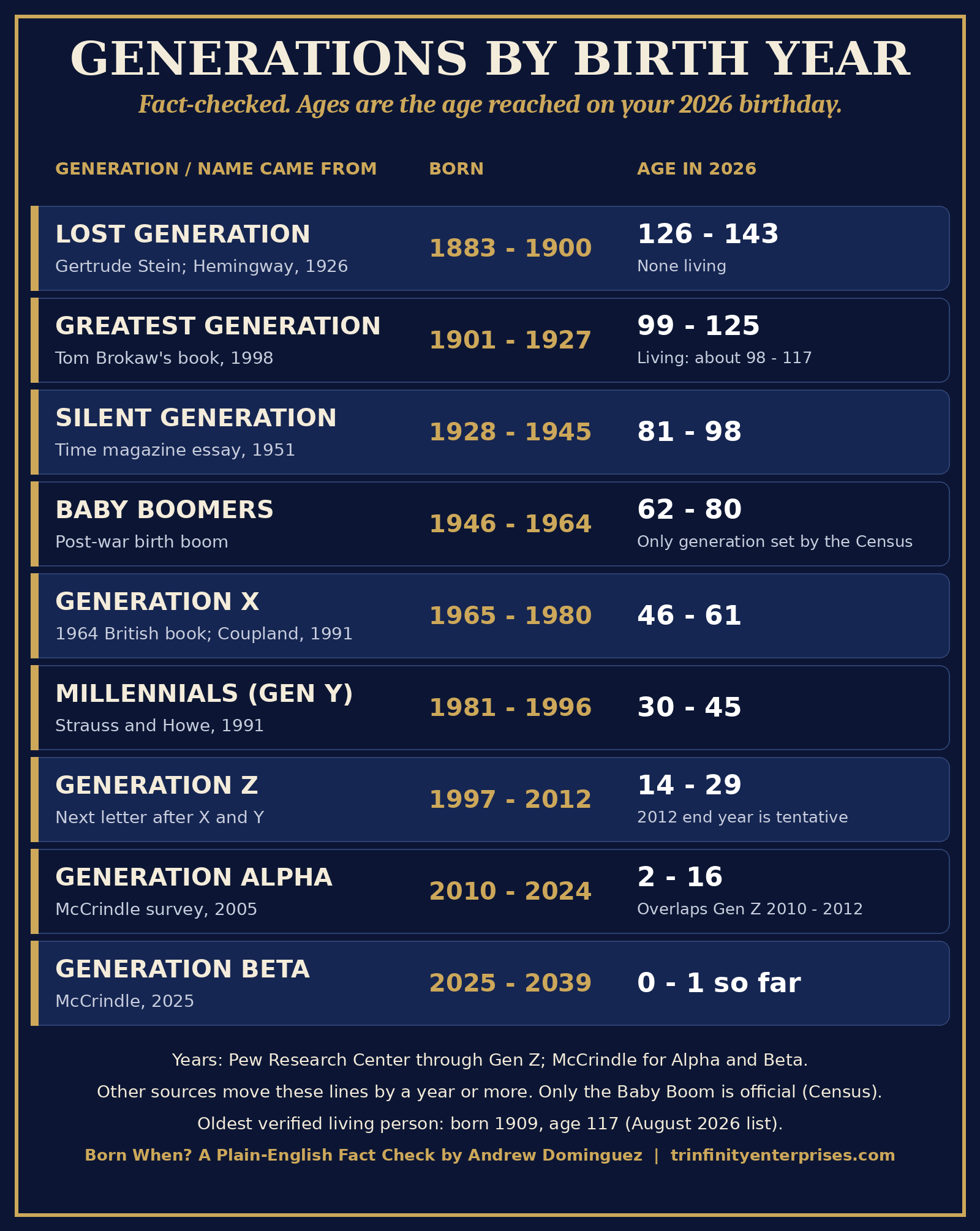
Find your birth year. Ages are the age reached on your birthday in 2026, using Pew years through Gen Z and McCrindle years for Alpha and Beta. Remember that other sources move these lines by a year or more.
| Born | Generation | Age in 2026 | Name came from |
|---|---|---|---|
| 1883-1900 | Lost Generation | 126-143 (none living) | Gertrude Stein, Hemingway (1926) |
| 1901-1927 | Greatest Generation | 99-125 (living: about 98-117) | Tom Brokaw (1998) |
| 1928-1945 | Silent Generation | 81-98 | Time magazine (1951) |
| 1946-1964 | Baby Boomers | 62-80 | Post-war birth boom; Census |
| 1965-1980 | Generation X | 46-61 | 1964 book; Coupland (1991) |
| 1981-1996 | Millennials (Gen Y) | 30-45 | Strauss and Howe (1991) |
| 1997-2012 | Generation Z | 14-29 | Follows X and Y; Pew (2019) |
| 2010-2024 | Generation Alpha | 2-16 | McCrindle survey (2005) |
| 2025-2039 | Generation Beta | 0-1 so far | McCrindle |
Gen Z and Gen Alpha overlap from 2010 to 2012 because Pew and McCrindle draw the line in different places. If you were born in those years, both answers are fair.
How I'd Use the Labels
Generation names are handy shorthand. They can help explain why a grandparent who grew up in the Depression won't throw out a good jar, or why a 20-year-old would rather text than call. They're good for starting a conversation.
Where it breaks down is when a label replaces knowing the person. A birth year can't tell you how someone was raised, what they believe or what they've been through. When you see a graphic that tells you what a whole generation is "known for," check the years, ask who drew the lines, and remember that the people on each side of a cutoff year have a lot more in common than the chart lets on.
Sources
Each number matches the small raised number in the text. Wikipedia pages were used to find and cross-check facts, and each one cites its own original sources.
- Mannheim, Karl. "The Problem of Generations." First published in German in 1928; English translation in Essays on the Sociology of Knowledge (London: Routledge and Kegan Paul, 1952). Summary: https://en.wikipedia.org/wiki/Theory_of_generations
- Wang, Richard J., Samer I. Al-Saffar, Jeffrey Rogers and Matthew W. Hahn. "Human generation times across the past 250,000 years." Science Advances, 2023. DOI 10.1126/sciadv.abm7047. News release: Indiana University via ScienceDaily, January 2023. https://www.sciencedaily.com/releases/2023/01/230106144515.htm
- Geiger, Abigail. "The Whys and Hows of Generations Research." Pew Research Center, September 3, 2015. https://www.pewresearch.org/politics/2015/09/03/the-whys-and-hows-of-generations-research/
- Dimock, Michael. "Defining generations: Where Millennials end and Generation Z begins." Pew Research Center, January 17, 2019. https://www.pewresearch.org/short-reads/2019/01/17/where-millennials-end-and-generation-z-begins/
- Pew Research Center. "How Pew Research Center will report on generations moving forward." May 22, 2023. https://www.pewresearch.org/short-reads/2023/05/22/how-pew-research-center-will-report-on-generations-moving-forward/
- Fry, Richard. "The oldest Baby Boomers turn 80 in 2026." Pew Research Center, January 9, 2026. https://www.pewresearch.org/short-reads/2026/01/09/the-oldest-baby-boomers-turn-80-in-2026/
- McCrindle. "Welcome Gen Beta" (Generation Beta defined). January 2025, updated June 2026. https://mccrindle.com.au/article/generation-beta-defined/
- Business Insider. "Here's Everything You Need To Know About 'Generation Alpha' - The Age Group Beyond Gen Z." https://www.businessinsider.in/heres-everything-you-need-to-know-about-generation-alpha-the-age-group-beyond-gen-z/articleshow/38983461.cms
- Sanburn, Josh. "How Every Generation of the Last Century Got Its Nickname." Time, December 2, 2015. https://time.com/4131982/generations-names-millennials-founders/
- Wallenfeldt, Jeff. "Silent Generation." Encyclopaedia Britannica. https://www.britannica.com/topic/Silent-Generation
- Masnick, George. "Defining the Generations." Harvard Joint Center for Housing Studies, November 28, 2012. https://www.jchs.harvard.edu/blog/defining-the-generations
- Raphelson, Samantha. "From GIs To Gen Z (Or Is It iGen?): How Generations Get Nicknames." NPR, October 6, 2014. https://www.npr.org/2014/10/06/349316543/don-t-label-me-origins-of-generational-names-and-why-we-use-them
- Thompson, Austin. "How Baby Boomers, Generation X, and Millennials Got Their Names." Mental Floss, May 1, 2018, updated April 10, 2024. https://www.mentalfloss.com/culture/generations/how-generations-named-baby-boomers-generation-x-millennials
- Hemingway, Ernest. The Sun Also Rises. New York: Charles Scribner's Sons, 1926.
- Brokaw, Tom. The Greatest Generation. New York: Random House, 1998.
- "Greatest Generation." Wikipedia, accessed November 2026 (cites Pew Research Center for 1901-1927). https://en.wikipedia.org/wiki/Greatest_Generation
- Strauss, William, and Neil Howe. Generations: The History of America's Future, 1584 to 2069. New York: William Morrow, 1991. Also The Fourth Turning. New York: Broadway Books, 1997.
- "Strauss-Howe generational theory." Wikipedia, accessed November 2026 (generation years and academic criticism). https://en.wikipedia.org/wiki/Strauss%E2%80%93Howe_generational_theory
- "Generation X (1964 book)." Wikipedia, accessed November 2026. https://en.wikipedia.org/wiki/Generation_X_(1964_book)
- Coupland, Douglas. Generation X: Tales for an Accelerated Culture. New York: St. Martin's Press, 1991.
- "Generation Z." Wikipedia, accessed November 2026 (Pew, Census, Library of Congress, Statistics Canada, Japan and Australia ranges, with citations to each). https://en.wikipedia.org/wiki/Generation_Z
- "Generation Jones." Wikipedia, accessed November 2026. https://en.wikipedia.org/wiki/Generation_Jones
- "Xennials." Wikipedia, accessed November 2026. https://en.wikipedia.org/wiki/Xennials
- "List of oldest people." Wikipedia, living list as of August 31, 2026. https://en.wikipedia.org/wiki/List_of_oldest_people
- worthknowingmedia. "Generations by Birth Year." Instagram post labeled "AI content," viewed November 15, 2026.