

The Home Apothecary: A Plain-English Guide to Healing Herbs and Plants
100 healing herbs and plants with photos, uses, how they work, what the research says, and the warnings you need, plus 14 deadly look-alikes.
Download free PDF (6.2 MB)Survival / Apothecary and Natural Remedies
Free herb and remedy search
Type an herb or a health problem and see what my two natural health books say about it: what it's used for, what the research says, the warnings, and when it's time to see a doctor.
Search the books
Every result comes straight from the text of The Home Apothecary (100 herbs and 14 dangerous plants) and Natural Remedies (47 illnesses and 29 injuries). Nothing is added. Before each search shows results, you'll be asked to confirm that you understand this is not medical advice.
Free to download
The search gives you the entry. The books give you the whole picture, including how to make teas and salves, how to gather wild plants safely, photos of every herb, and the full source list.
100 healing herbs and plants with photos, uses, how they work, what the research says, and the warnings you need, plus 14 deadly look-alikes.
Download free PDF (6.2 MB)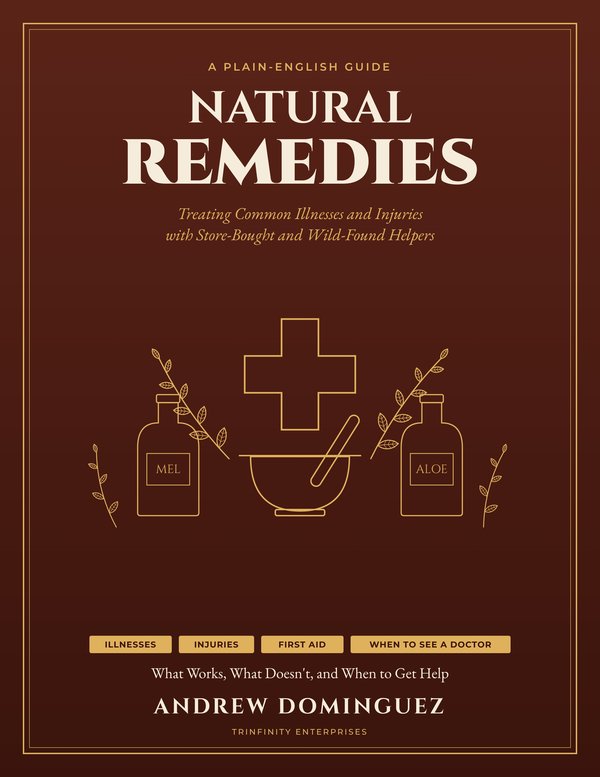
Self-care, store-bought remedies, and wild helpers for 47 illnesses and 29 injuries, with a See a Doctor box in every entry.
Download free PDF (1.6 MB)Read this first
Herbs are real medicine. That's why they can help, and it's also why they can hurt. Natural does not mean safe. This part comes straight from The Home Apothecary.
Pregnant and breastfeeding women. Many herbs have never been tested in pregnancy. Some, such as pennyroyal, mugwort, feverfew, and high doses of sage, can stimulate the uterus or harm a baby. Unless a doctor or midwife says otherwise, keep herbs during pregnancy to normal food amounts, like the ginger or peppermint you would cook with.
Babies and children. Children are not small adults. Their livers and kidneys handle chemicals differently. Never give honey to a baby under 12 months old because of the risk of infant botulism. Never put peppermint or eucalyptus oil on or near a baby's or young child's face, because the menthol and cineole can affect breathing. Keep every essential oil out of reach. A few swallowed teaspoons of some oils can kill a toddler.
People taking prescription drugs. This is the biggest danger in herbal medicine. Herbs can raise or lower the amount of a drug in your blood. St. John's wort is the most famous example. It speeds up the liver enzymes that break down many drugs, including birth control pills, blood thinners, transplant drugs, and HIV medicines, and it can make them fail.
People on blood thinners or heading into surgery. Garlic, ginkgo, ginger in large amounts, feverfew, and several others can increase bleeding. Most surgeons ask you to stop all herbal supplements about two weeks before an operation.
People with liver or kidney disease. Your liver breaks down most herbs. Several, including kava, chaparral, comfrey, and some concentrated green tea and turmeric extracts, have been linked to liver injury.
People with allergies to ragweed or daisies. Chamomile, echinacea, feverfew, calendula, arnica, yarrow, and milk thistle are in the same plant family as ragweed and can cause allergic reactions.
People with autoimmune disease. Herbs promoted to "boost the immune system," such as echinacea, astragalus, and cat's claw, may not be a good idea if your immune system is already attacking your own body.
These are the most important interactions for the herbs in the books. It is not a complete list. Always ask your pharmacist before adding an herb if you take any prescription drug.
| If you take... | Be careful with... | Why |
|---|---|---|
| Blood thinners (warfarin, apixaban, rivaroxaban, clopidogrel) or daily aspirin | Garlic, ginkgo, ginger (large amounts), feverfew, dong quai, devil's claw, cat's claw, turmeric, flaxseed, willow bark, meadowsweet, bromelain, red clover, St. John's wort, green tea (vitamin K), nettle (vitamin K) | More bleeding, or blood thinner works less well |
| Birth control pills, patches, or rings | St. John's wort (and possibly chamomile) | The birth control can fail |
| Transplant and immune drugs (cyclosporine, tacrolimus) | St. John's wort, schisandra, echinacea, astragalus, ashwagandha, cat's claw | Drug levels go down or up; organ rejection |
| Antidepressants (SSRIs, SNRIs, MAOIs, tricyclics) | St. John's wort, Mormon tea and other ephedras, rhodiola | Serotonin syndrome, blood pressure spikes |
| Sedatives, sleeping pills, anxiety drugs, opioids, alcohol | Kava, valerian, passionflower, hops, skullcap, lemon balm, catnip, ashwagandha, lavender capsules, chamomile (large amounts) | Too much drowsiness, slowed breathing |
| Diabetes drugs (insulin, metformin, sulfonylureas) | Fenugreek, prickly pear, cinnamon, aloe by mouth, holy basil, black seed, American and Asian ginseng, goldenseal (lowers metformin), moringa, devil's claw | Blood sugar drops too low, or drug works less well |
| Blood pressure drugs | Hibiscus, black seed, licorice (raises pressure), hawthorn, cat's claw, rhodiola (losartan), green tea (nadolol) | Pressure goes too low, or drug works less well |
| Digoxin and heart rhythm drugs | Licorice, senna, cascara, aloe latex, hawthorn, St. John's wort, horsetail | Low potassium and other effects make rhythm problems more likely |
| Water pills (diuretics) and lithium | Dandelion, horsetail, nettle, juniper, cleavers, licorice | Salt and fluid imbalance, lithium builds up |
| Thyroid medicine | Ashwagandha, lemon balm, moringa | May change thyroid levels |
| HIV medicines | St. John's wort, garlic supplements | Drug levels fall |
| Any prescription drug taken by mouth | Psyllium, flaxseed, marshmallow, slippery elm | Fiber and gel slow absorption; separate by 2 hours |
Do not use these herbs in medicine-sized amounts while pregnant unless your own doctor or midwife specifically recommends it. Food amounts of culinary herbs such as ginger, garlic, cinnamon, fennel, sage, and rosemary are generally fine.
Aloe (by mouth), arnica, ashwagandha, astragalus, black cohosh, black seed (large amounts), boswellia (medicinal amounts), burdock, butterbur, cascara, cat's claw, catnip, chasteberry, chaparral, comfrey, dong quai, elecampane, fenugreek, feverfew, ginkgo, Asian and American ginseng, goldenseal, hibiscus (large amounts), hops, horse chestnut, horsetail, juniper, kava, lemongrass (medicinal amounts), licorice, meadowsweet, Mormon tea, motherwort, mugwort, passionflower, pine needle tea, red clover, sagebrush, sage (medicinal amounts), saw palmetto, schisandra, senna (unless prescribed), skullcap, slippery elm (whole bark), St. John's wort, uva ursi, white willow, yarrow, yellow dock. Also every plant in Part Three, and pennyroyal in any form.
The fine print
Last updated November 18, 2026. By using the search on this page or the books it links to, you agree to these terms. If you don't agree, please don't use them.
Andrew Dominguez and Trinfinity Enterprises are not medical doctors, nurses, pharmacists, herbalists, or licensed health care providers of any kind. Nothing on this page or in these books is given as a licensed professional.
Everything here is general information for learning only. It is not medical advice, a diagnosis, or a treatment plan, and it is not a substitute for care from a licensed health care provider who knows your health history. Using this page does not create a doctor-patient or any other professional relationship. Never ignore professional medical advice or wait to get it because of something you read here.
You are responsible for checking every herb, plant, food, oil, and product for allergies before you use it or give it to someone else. Any of them can cause an allergic reaction, and a severe reaction (anaphylaxis) can kill. Test a small patch of skin first for anything used on the skin. If you notice swelling of the face or throat, hives all over, trouble breathing, or fainting, call 911.
These statements have not been evaluated by the Food and Drug Administration (FDA). This information is not intended to diagnose, treat, cure, or prevent any disease.
Check with your doctor or pharmacist before you use any herb, supplement, or remedy, and before you change or stop any medicine. This matters most if you:
In an emergency, call 911 right away. For a possible poisoning from a plant, mushroom, medicine, or chemical, call Poison Help at 1-800-222-1222, even if the person feels fine. If you or someone you love is thinking about suicide, call or text 988. Do not use this page in place of emergency care.
Several deadly plants look like useful ones. Never eat, drink, or put on your skin any wild plant unless you can identify it with 100 percent certainty. A photo or a description on a web page is not enough to identify a plant. Know the laws and landowner rules where you gather.
The books were checked against the sources listed in them and are current as of November 2026. Research on herbs changes, products vary in strength and purity, and people react differently. We try hard to be accurate, but we can't promise that every detail is complete, correct, or up to date. We may change or remove this page, the books, or these terms at any time.
You are responsible for your own health decisions. Any use of this information is entirely at your own risk.
This page and the books are provided free and "as is," without warranties of any kind, express or implied, including any warranty of accuracy, fitness for a particular purpose, or results.
To the fullest extent the law allows, Trinfinity Enterprises, Andrew Dominguez, and anyone working with them assume no responsibility or liability, and will not be liable, for any injury, illness, loss, or damage of any kind, direct or indirect, that comes from using or relying on this page, the search results, or the books.
The search runs in your own browser. The words you type are not sent to us or stored by us. The site counts page visits and PDF downloads, as explained in our privacy policy.
The Home Apothecary and Natural Remedies are copyright 2026 Andrew Dominguez, all rights reserved. They are free to download for personal use. They may not be sold, republished, or reproduced without written permission.
These terms are governed by the laws of the State of Nevada. Questions? Use the contact page.
More ways to get ready: see the Survival page, or see all my books.